


-
Ingrid Halland (b. 1988) is an art and architecture historian and art critic. She is Associate Professor of Aesthetics and Culture at Aarhus University and Associate Professor II at the University of Bergen.
In collaboration with Marte Johnslien, she leads the research project TiO2: How Norway Made the World Whiter .
She is the editor of the publishing platform Metode , run by ROM for art and architecture.
Waste values
1. Greystone
In 1961, Titania’s structural engineer, Claus Egil Feyling, met local artist Werner Otto Lichtenberg for an interview for Titania’s magazine Ilmenitten . Feyling described Lichtenberg’s self-built home and studio near Jøssingfjord this way: “Built of grey stone from the site and timber from an old sea shed, combined in architectural lines, [the house] does no violence to nature, but stands as it should have stood for thousands of years.”
Lichtenberg (1903–1987), who was born in the German province of Posen (now Poland), raised in Berlin, came to Norway (Lista) as a young man, and settled in Sokndal. He had art education in Munich, Düsseldorf, Vienna and Berlin and traveled frequently in Europe. As a young man he walked barefoot from Budapest to the Caspian Sea, and later in life he went to Italy every year in a Volkswagen. Lichtenberg's artistry had great importance locally, but has rarely been mentioned in Norwegian art history.
Near Jøssingfjord, Lichtenberg built his home and studio with materials from the surrounding area. He painted the sea, the cultural landscape along the fjords, and people he knew well. “I live for beauty ... a very small thing can have a great value,” Lichtenberg said in an interview with Okka TV, Dalane’s local TV station. He used various materials to bring out the color nuances in nature: charcoal, toothpaste, and shoe polish. He used both the expensive blue pigment lapis lazuli (also called ultramarine, which means “beyond the sea”) and the new acrylic paint titanium white [fig. 1] – with raw materials extracted from the mountains behind the fjord where he lived.
Werner Otto Lichtenberg's materials, paint tubes and brushes. Including blue pigment lapis lazuli, shoe polish, charcoal and titanium white.
Photo: Ingrid Halland, 2024
2. Concrete
On a hill above Jøssingfjorden, the radical Canadian architect Robert Esdaile (1918–1987) was offered a plot of land in 1964. Together with his family, he had spent two summers in tents on the site. The site had been a defense facility during World War II, built by the Germans to protect the Titania mine that had been taken over by the Germans. In the existing concrete foundation built for the large cannon, Esdaile built a house from materials he either found on site or carried up on foot [fig. 2]. “The house designed itself according to strict physical and economic conditions,” Esdaile wrote when describing the design of the cabin. The cabin had neither electricity nor insulation, and the fireplace was constructed from an old sewer pipe.
His goal was to build a house in a way that caused the least possible destruction of nature, in contrast to “what is really destroying Jøssingfjorden [which] is of completely different dimensions.”
On the other side of the mountain, Titania was digging deeper and deeper into the ground, and a continuous stream of waste had been pumped into the fjord since the 1950s. Esdaile wrote about “Titania’s pollution of the entire fjord and coastline,” and pointed out that “this company is dumping thousands of tons of sulfurous sludge every day. The fish have become inedible in Jøssingfjorden while the muck is spreading along the coast, forcing more and more small-scale fishermen to give up their profession and join the new generation of industrial workers.” He concluded his article about the recycled concrete hut by stating that “nature is giving way and changing.”
Fig. 2 – Robert Esdaile, photograph from the article “Jansholtet: Cabin by Jøssingfjord”, Byggekunst 1, no. 58 (1976), pp. 6-7.
3. Waste
Throughout the 2020s, Maiken Stene and Hans Edward Hammonds have built a new, international art community based on the history of mining and industry in the area around Jøssingfjorden. Titania's activities are not only the background, but the very starting point for many of the art projects: the disappearing mountain, the change of nature, the presence of titanium white pigment, the welfare schemes of the labor movement and the remnants of industrial operations are materials that the artists work directly with.
Velferden , Sokndal scene for contemporary art, can be seen in connection with Lichtenberg's site-specific paintings and Esdaile's cabin built on an old cannon foundation; three different art projects related to the site and its concrete materials.
The difference is that whereas Lichtenberg and Esdaile were more on the outside commenting on developments, Velferden from within, in the midst of the material, economic and global circuits that industrial production of titanium white is part of. Lichtenberg said that “a rather small thing can have a great value”, but in Velferden The value lies not primarily in the individual objects, but in the actions: in the slow building of an art environment, in the collaboration with the local community and in the work of taking the place seriously.
The 9 artists participating in WASTE / DEPOSIT have worked on site over time, examining waste as both a problem and a raw material. In the works that emerged from the process, the deposit is both motif, material and method. As with Esdaile, strict frameworks and limited resources are an ethical starting point; the artists in WASTE / DEPOSIT consciously work within the economic, material and ecological constraints set by the site. In this way, the waste – the remains after the extraction – becomes not just the end of a process, but the starting point for new narratives and new ways of working.
Claus Egil Feyling, "On a foray along familiar paths", Ilminitten, winter 1961, p. 29.
Robert Esdaile, "Jansholtet: Cabin by Jøssingfjord", Byggekunst 1, no. 58 (1976), pp. 6-7.
"Jansholet in Jøssingfjord", Hytteliv 3 (1996), pp. 2-6.
Esdaile, "Jansholtet", p. 7.
Ibid.
MORE FROM WASTE / DEPOSIT :
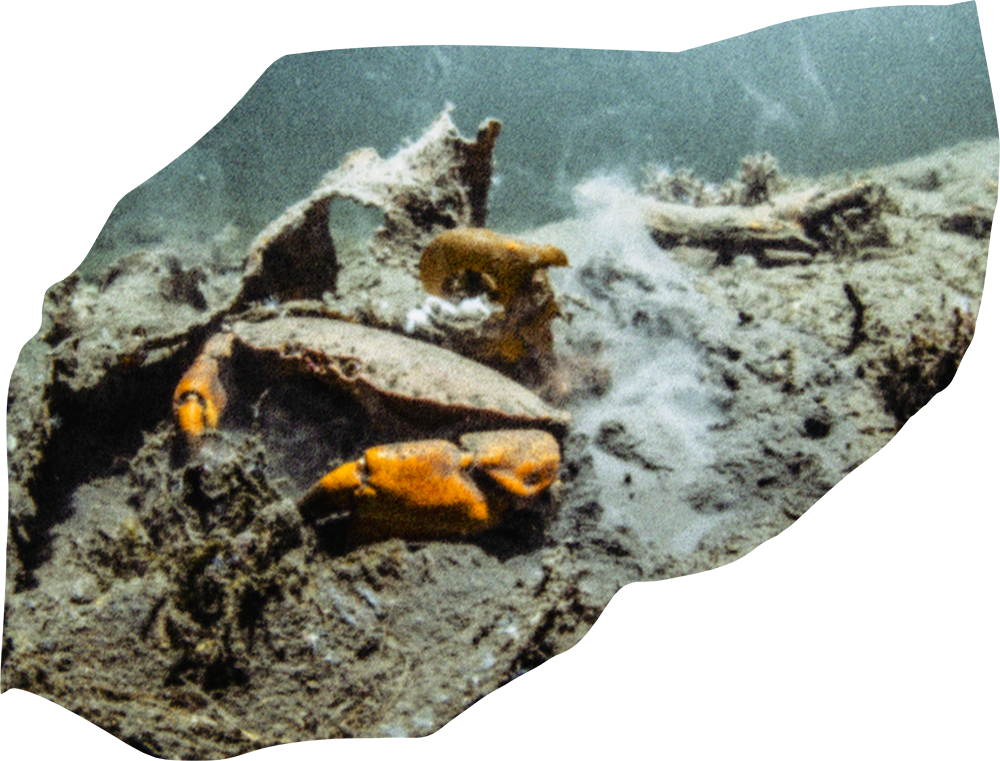
ERLING SVENSEN / marine photographer
SIMON DANIEL TEGNANDER WENZEL / visual artist
BEN HIPKISS / welfare crew