


-
Stephanie O'Rourke is a historian of eighteenth- and nineteenth-century European art, particularly with regard to resource extraction, scientific knowledge, and media technologies.
She is an associate professor of art history at the University of St Andrews in Scotland.
In 2024 she was "professeur invité" at the Sorbonne in Paris, and in 2026 she is a "Mid-Career Fellow" at the Paul Mellon Center for Studies in British Art in London.
"Curclaze Tin Mine", Cornwall , 1813.
The sublime garbage heap
Mining diagrams from the 18th and 19th centuries tend to represent waste as the absence of a desired resource – areas considered “waste” are often blank on mining maps, for example. Ironically, waste has done more to physically alter the landscape around a mine than almost any other aspect of mining, especially when it comes to the large tailings piles that become their own topographic formations. These piles also effect the dramatic inversion of “above” and “below” in a landscape, using the vertical depths of the earth that are usually out of sight to produce a structure raised above the surface.
One example is the sharp, towering peaks of white waste heaps that dominate the landscape around St. Austell (a former site of china clay mining in England), reminiscent of the alpine landscapes we associate with the sublime. Their nickname, the Cornish Alps, confirms that the presence of industrial waste has transformed the English picturesque landscape into a Swiss sublime landscape.
In other words, it recognizes that waste has caused an aesthetic transformation of the environment, as well as a physical one.
The Cornish Alps
Photo: Tony Atkin / CC BY-SA 2.0
Historically, industrial waste has rarely been the subject of artistic representation. As with engineering diagrams, the most visible aspects of a mining landscape – the mountain-like conical piles of waste material – have been practically invisible. (Rare exceptions to this include the works of Belgian artist Constantin Meunier and early North American mining photography.) This tension between visibility and invisibility is endemic in mining landscapes, where the physical environment is actively shaped and determined by underground activities that cannot be seen.
However, waste is a fluid category: an object or material can move in and out of it. Waste is that which lacks readable value in a given context.
For example, the gas used to light Europe’s capitals in the 19th century was originally discarded as “waste,” generated during the production of coke, a coal-based form of fuel. It was not until the late 18th century that serious efforts were made to capture and reuse the gas emitted from coking. Within just a few decades, coal gas was lighting homes and streets in city centers across Europe and North America. The very appearance of cities was permanently transformed by the widespread presence of gas-powered streetlights in the 19th century—another example of the dramatic visual power of 19th-century mining waste.
“A Peet at the Gas Lights in Pall-Mall”, Thomas Rowlandson, 1809.
Coking also produced other forms of waste, such as coal tar. Most of the coal tar was initially discarded, but in the 1850s, experiments showed that this “waste” could be used to produce colorful industrial dyes and chemicals for photography. Soon, artists’ oil paints were also made with coal tar. The black, sticky waste could produce dazzlingly colorful paintings. Photography itself was in many ways a product of the mine. Art creation has always involved the transformation of waste. In the Renaissance, for example, sculptors were known to reuse leftover wax and metal from other projects in new works. Old canvases, discarded rags, and soot were among the forms of waste regularly used to make art supplies. The production of paint with urine dates back thousands of years, but remained an important practice in the late 19th century.
The mining landscape is in tension between "above" and "below", "visible" and "invisible", "waste" and "non-waste".
But mining also creates new opportunities for materials to transition between these categories. And art, in its own way, can give value to materials where it previously could not be seen.
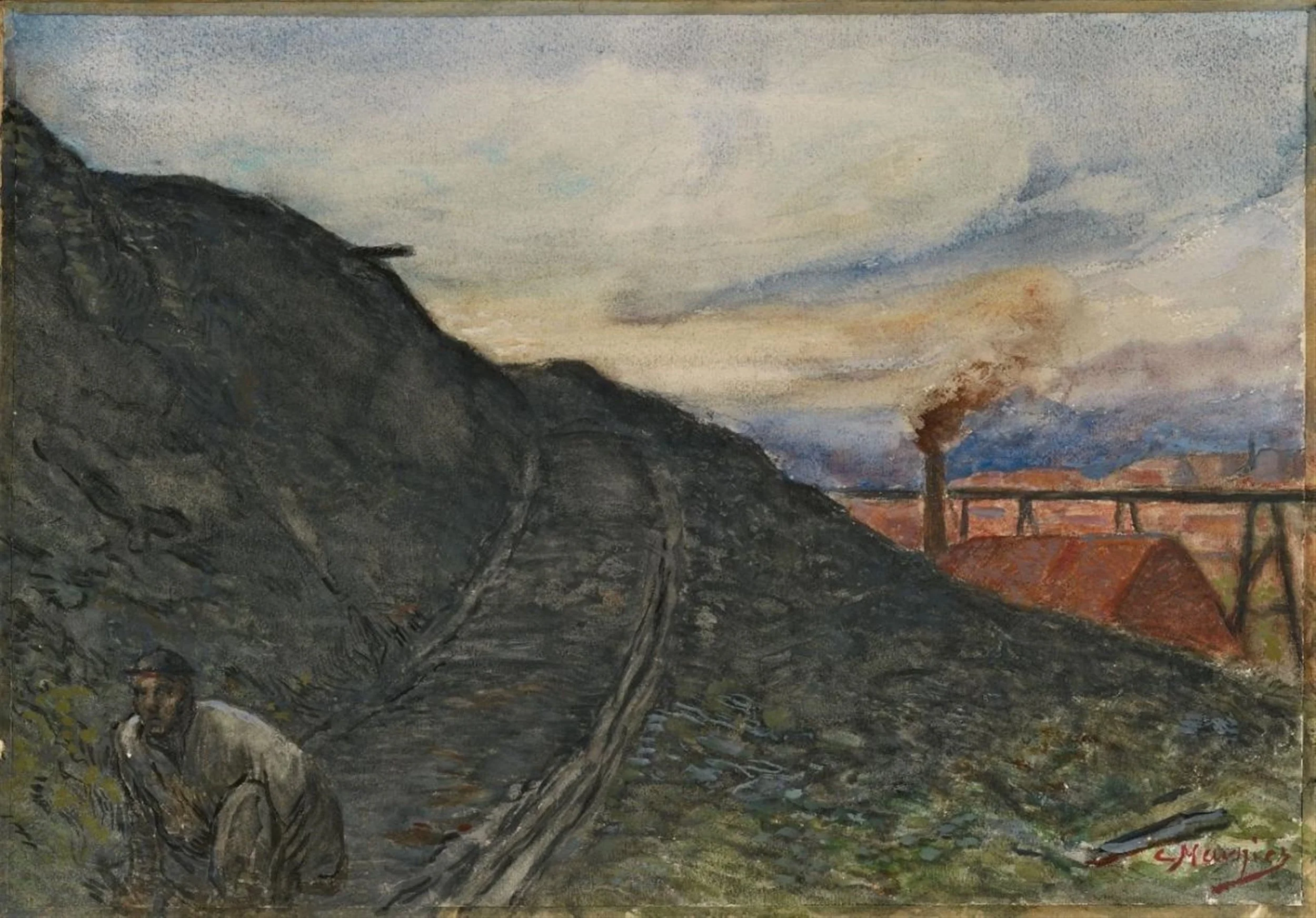
“Path Descending from a Slag Heap”, Constantin Meunier.
MORE FROM WASTE / DEPOSIT :
LISA TORELL / visual artist
PAUL MAGNUS LUNDØ / filmmaker

JARL BIRKELAND / amateur entomologist