


-
Rune Haaland (b. 1960) is a Norwegian environmental activist, who began his environmental involvement in Jæren Natur og Ungdom in 1976. In 1986, he and Frederic Hauge founded the environmental foundation Bellona, which Haaland left in 2002.
New mineral policy
In the early 80s I was the leader of Jæren Nature and Youth. We started the first actions against Titania in the summer of 1983. We first set up an action camp in Knubedal with a view of Dyngadjupet, where they had given permission to dump mining sludge. After a week, the camp was moved to Jøssingfjord due to easier logistics. Journalists had to walk over the mountain to visit the camp. We stayed there for several weeks. Greenpeace also visited us, with a sailboat and two inflatable boats, and we continued to press forward with various actions.
In 1986, Frederic Hauge and I founded Bellona, as Natur og ungdom is a youth organization, and we were starting to get too old. We continued to press through actions where we hung banners on the facade of the Ministry of the Environment, and occupied the office of Minister of Environmental Protection Sissel Rønbeck twice. We sent many questions to the Norwegian Pollution Control Authority. The Institute of Marine Research sent a research vessel that detected the dispersion of mine particles from Titania's disposal at Dyngadjupet.
We were early adopters of new communication technology, and used, among other things, the secretarial services of the Norwegian Telecommunications Administration – phono-telex/teletypewriter – to send out press releases to newspaper editorial offices.
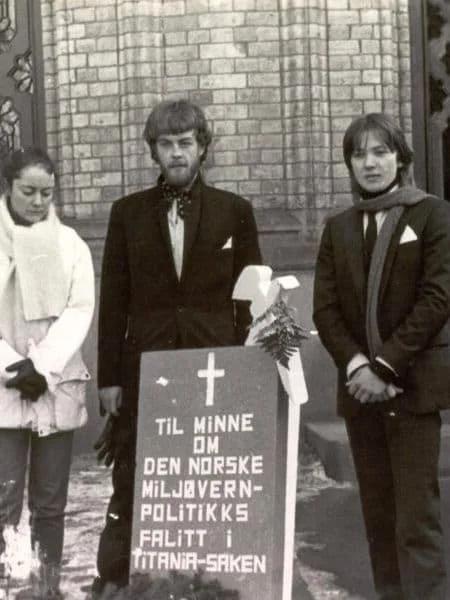
Photo: Nature and Youth
On August 4, 1984, Natur og Ungdom blocked the Titania loading facility. I was sitting in an apartment in Sandnes with a landline, and sent a press release to NRK. A few minutes after it was sent, the text was read out in the first news broadcast at 06:00. We used the media in a more effective way than before in the environmental fight, and it was the media push that made things happen.
When we announced Bellona at a press conference at the Oslo Press Club, we launched the term "environmental crime".
It was incorporated as a new word by the Language Council in 1986-87. For 11 years I gave lectures at the Police College for investigators in further education. They came from all over the country and were experienced investigators who had been trained in the law and Bellona's experiences in exposing environmental crime. Jørn Holme, who later became the head of the Norwegian Police Service, was also one of the lecturers.
The second cargo facility operation was carried out in 1989. Then a civil defense was mobilized against us who were chained up: Frederic, two girls and I were chained up in the new cargo facility in Jøssingfjord. We had our own support team on the ground, consisting of, among others, marine hunter Anders Lycke and Arne Åsbjørn Drangeid from Bryne who had experience as a UN soldier in Lebanon. There was a large crowd that came, there were many American cars and the "moustache company" came marching rhythmically to beat us. It was an extremely heated situation, we were kicked and hosed down with a fire hose into the survival suits we were wearing. We locked ourselves out of the chains and made the V sign with our fingers (like Winston Churchill). Then the crowd of curious people on the ground floor started to go berserk. They attacked our cars, but we walked calmly down from the cargo facility and drove to Egersund where we were met by the then editor of Dalane Tidende, Gunnar Kvassheim. Gunnar later became State Secretary at the Prime Minister's Office under the Bondevik government. From local contacts in Sokndal we learned that the plan was to take Frederic and me, strip us naked and place us in the winter cold, chained in our own chains at the local garbage dump at Svåheia between Sokndal and Egersund. Bellona's story could have stopped there and then, but fortunately it went well, because we locked ourselves out and left the loading facility.
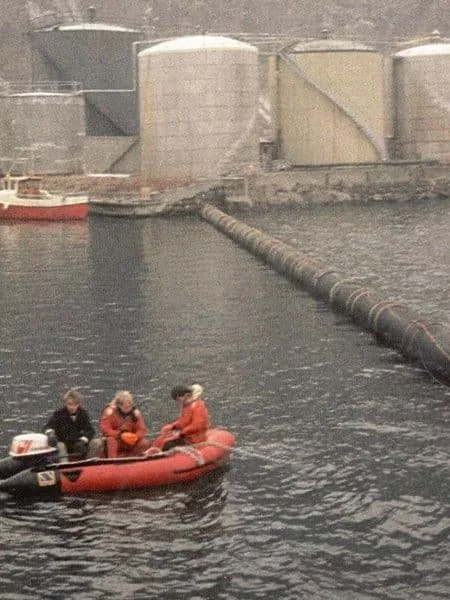
Photo: Nature and Youth
In the wake of this, the Ministry of the Environment decided to go to Sokndal to meet with fishermen, the municipality, the company and Bellona. While we were waiting to meet with the Minister of the Environment, Kristin Hille Valla, we heard noise from a group of people who came marching up the stairs and stood in front of us and asked us to get out of the way. The Minister of the Environment heard the noise and asked the case officer Anders Haugestad to lock the door to the meeting room (incidentally, the son of lawyer Arne Haugestad, who, among other things, led the people's movement against the EEC in 1972). This experience must have been perceived as quite dramatic for the Minister of the Environment. It did not take many weeks from this incident until the government decided that the mining waste should be deposited in a safe landfill instead of at Dyngadjupet outside Jøssingfjord.
Titania's management created a narrative that the company would go bankrupt if they had to dump the waste in a landfill, and since it was the village's cornerstone company, people were afraid of losing their jobs. We were heroes everywhere else because we fought to preserve nature. At that time, there was significantly more pollution in industry and agriculture than today - now billions have been invested in companies that do not pollute. Most of the smelters look different now, a lot has changed.
If the government had not stopped the dumping in the sea, according to calculations made by the Institute of Marine Research, by Jan Aure and Svein Sundby, a minimum of 100,000 tons of the most finely ground particles with toxic metal oil on the surface would have been spread annually outside Dyngadjupet to surrounding spawning and nursery areas for Norwegian spring-spawning herring on Siragrunnen and the shrimp field west of Dyngadjupet, i.e. the Boen field. On land, you can control the runoff and take measures. In the sea, it is practically impossible to know what is spreading.
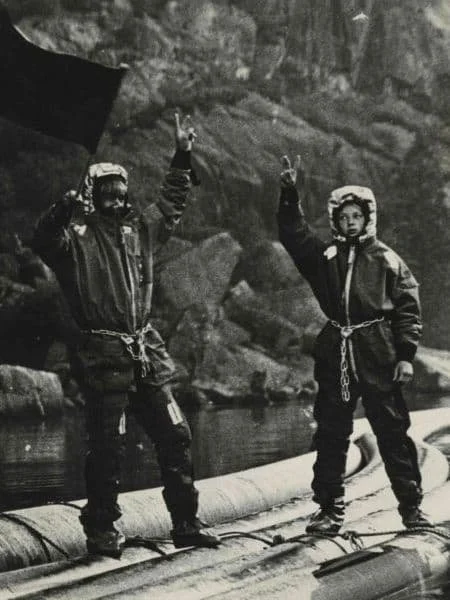
Photo: Nature and Youth
We had the Norwegian Fishermen's Association, the trawler owners and a bunch of different organizations on our team in the fight to protect the "food plate" in the sea. The Titania case was big in the 80s.
Bellona was on Dagsrevyen every week in the fall of 1987, wearing red overalls, chains and excavators.
The late 1980s were Bellona's golden age. Politicians began to tighten up, industry stepped up environmental investments, modernized and cleaned up unacceptable environmental conditions.
Surveys of contaminated land were conducted, investments were made in new processes, air and water purification plants – there were major process changes in many companies. New engineers came on board and withholding facts became "out".
There are still historical sins, including tens of tons of mercury from the closed chlor-alkali factory of Borregaard, in the outlet of the Glomma. It is almost inconceivable to think that the state and the municipality of Fredrikstad fail to understand what messing with contaminated sediments with grab dredging when there is a current of several knots in the Glomma leads to. The test dredging they did a couple of years ago has now led to an increase in mercury in marine life also on the Swedish side.
We as a society and industry have learned a lot from the mistakes of the past, but there is little indication that the Norwegian government and its companies, such as the Norwegian Coastal Administration, understand that one must clean up environmental toxins in the sea with caution to avoid them becoming available for uptake by fish and birds. There is still a cocktail of historical environmental toxins buried in harbor sediments in Norway.
As an environmentalist, I don't like landfills at all.
I think the future solution for Titania and other mining companies that produce large amounts of tailings is to see it as a resource, rather than a problem. We need to go back to the old slogan of Jæren Natur og Ungdom: “pollution is resources on the way”. There are several valuable minerals in the tailings that are not extracted, but are deposited in Titania’s landfill.

Photo: Nature and Youth
The shame about the Norwegian mineral strategy is that we have left it all to foreign actors who plunder resources from Norwegian mountains and move the profits out of the country. It is different from when we developed the shelf with oil. That upstanding elected officials are unable to conceive of introducing a land rent tax on minerals is still a mystery to me. The Christian Democratic Party has this on its agenda, and Sokndal municipality's mayor in the previous term, Jonas Andersen Sayed, is now a member of parliament and is working to gain understanding for this. He was once the country's youngest mayor, and understands what income both the municipality and the state are missing out on because we are unable to tax wisely.
The emission requirements for the mining industry are among the most pathetic in the world. Only Norway and Papua New Guinea still accept that mining waste is deposited in the ocean. We must think long-term if we are to take care of nature for our descendants. The environmental clause of the Constitution is unique in this respect, since it requires us to ensure that the environmental condition is intact for future generations. Facilitating a mineral industry that does not pollute and that utilizes the resources in the waste should have been a matter of course and something we should have learned as a result of the great environmental case of the 1980s – the Titania case.
Instead, we see government lawyers fighting the Norwegian Association for the Conservation of Nature, the Sami people, and Nature and Youth when they try to stop the discharge of mining waste in Repparfjord and Førdefjorden. Norway has the opportunity to become a leader in environmentally friendly mineral extraction, through, among other things, introducing a land rent tax and perhaps also setting up a separate state enterprise ala Statoil for environmentally friendly mineral extraction.
MORE FROM WASTE / DEPOSIT :
INGVILD STENE / welfare crew
ERLING SVENSEN / marine photographer
STEPHANIE O'ROURKE / researcher